Why Work With a Palliative Care Counselor?

Palliative care is a specialized therapeutic lens focusing on improving a person’s quality of life by addressing the physical, emotional, relational, practical, and spiritual challenges that often accompany serious illness.
It recognizes that symptom management includes more than physical comfort. It also includes supporting emotional distress, family dynamics, grief, uncertainty, moral distress, and the difficult conversations that accompany serious illness and end-of-life care.
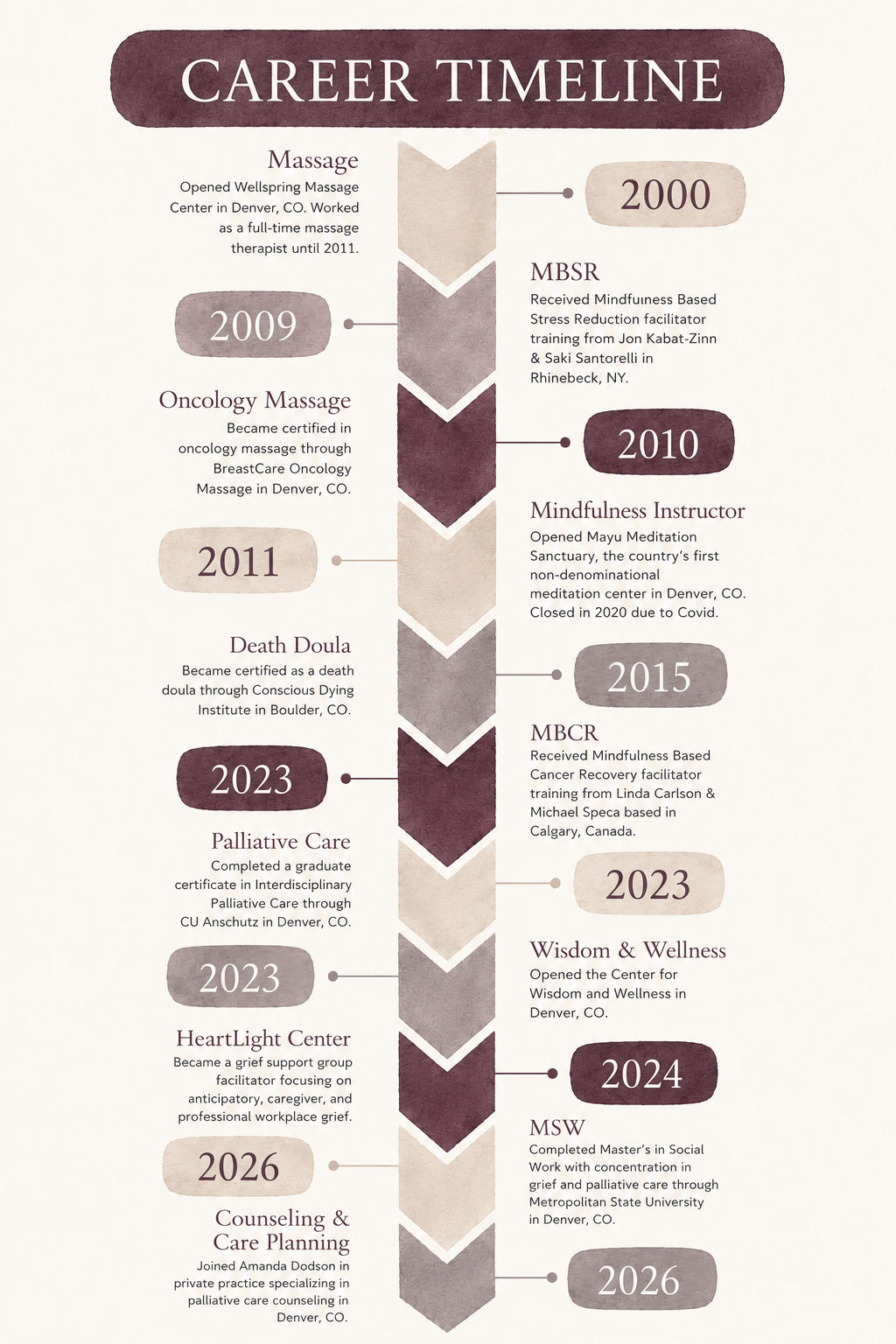
As a palliative care counselor, I understand the realities of interdisciplinary healthcare, the cumulative impact of caring for patients and families, and the emotional complexity of conversations about prognosis, suffering, and the dying process.
Whether you're living with illness, caring for someone you love, or supporting patients professionally, my role is to see you as a whole person – not your diagnosis or your job title – and to address your pain with curiosity, compassion, and respect.
Together, we can make room for the questions, emotions, and fears that deserve as much attention as the medical care itself.
Cierra McNamara, MSW, LSW
Palliative Care Social Worker
About Me

Cierra McNamara, MSW, LSW
Palliative Care Social Worker
Why palliative care counseling?
Many people assume working with illness, grief, and loss is difficult and depressing. That’s never been true for me. Quite the opposite. I’ve learned that working with people through their darkest days has a way of illuminating what’s most important in life: connection and compassion.
Throughout my life I’ve been drawn to contemplative practices, interested in answers to age-old questions: Why are we here? What really matters? How do we minimize suffering?
In a fast-paced world focused on things that are superficial and temporary, I found synergy among people wrestling with broken bodies, unexpected losses, and unbearable responsibilities.
Life-examination that happens in the face of pain and helplessness is life-changing.
For me, this is the definition of healing.
When I’m with people who are buried in questions but still courageously look for answers, I am inspired. I feel a connection not only to them, but to the entire mystery of life, which fills me with wonder and gratitude.
My aim is to provide space and support, giving you permission to explore the depths of your sorrow and the edges of your fear, eventually helping you find a calmness in your core.
My Philosophy
Healing can happen every day.
Despite treatments. Regardless of outcomes.
In subtle moments that can radically repair wounds of a lifetime.

Perspective
Change happens when we can notice our experiences rather than fight them.
Perspective lets us view life through a more helpful lens.
Compassion
Suffering diminishes when we recognize pain is part of the human condition.
Compassion holds space no matter the weight of suffering.
Harmony
Connection is restored when we recognize the cycles of life within us and around us.
Harmony is the essence of belonging.

The evidence-based therapeutic tools I use – namely ACT, Mindfulness-Based Therapy, Narrative Therapy, and Somatic Therapy – integrate to build skills that are particularly suited for shifting perspective, building compassion, and restoring harmony.